

Don’t forget about my short story collection, Fire and Stone. The campaign lasts only one more day. Claim your exclusive copy now for as little as $10.
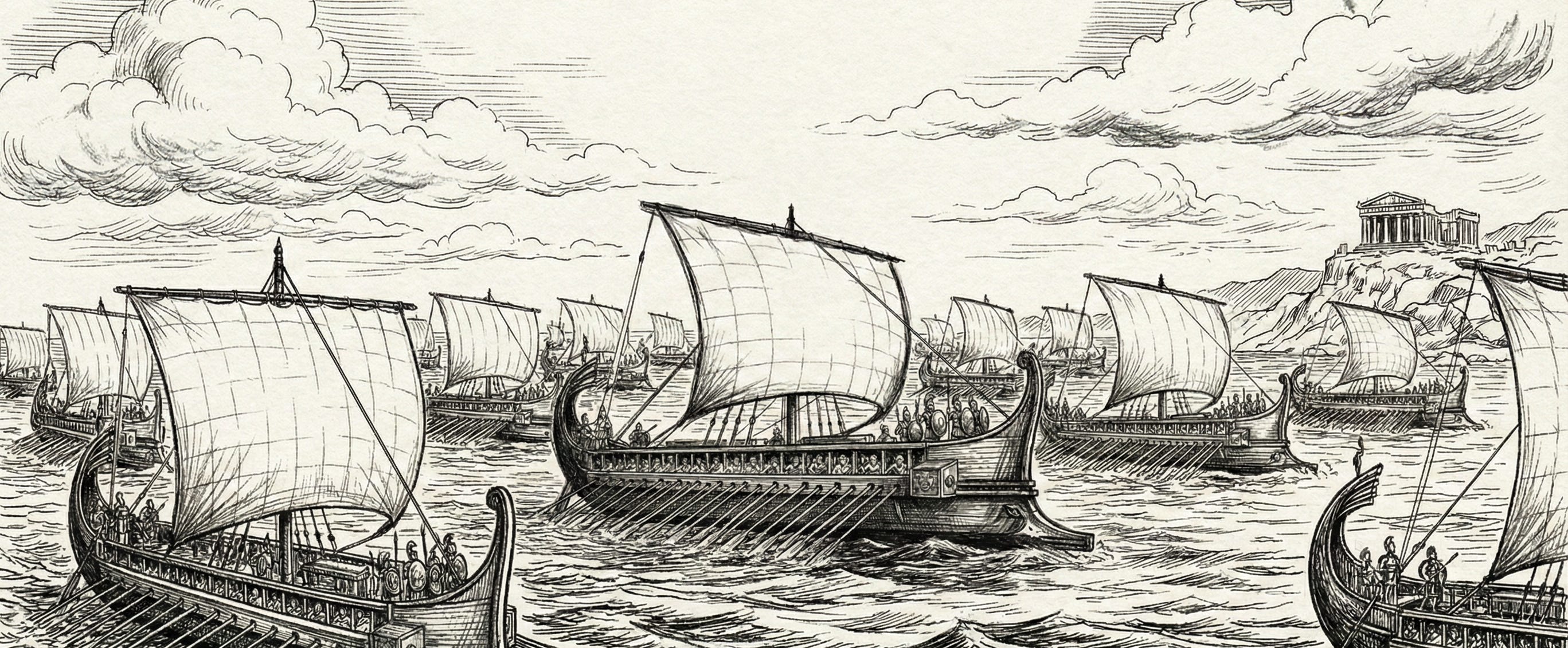
The Athenian Empire ruled the islands of the Aegean Sea with superior naval might and craft. What started as a voluntary alliance against Persia devolved into a relationship of a powerful state lording over weaker vassals, and when Naxos attempted to leave the “alliance”, Athens subjugated the city and forced it to return.
This shift in power happened gradually, and Thucydides lays most of the blame not on Athens herself, but on the growing softness of the allies. Athens did what any powerful state would do when it suddenly found an empire in its hands. Might as well blame a mother bear for protecting her cubs.
At first, the allies contributed to the alliance with ships and service, sending men into direct action. This arrangement became tiresome, however, and they preferred to start paying more in tribute instead. Athens would get money to build and equip ships, and Athens would handle all martial matters. Only Athens would fight naval battles. Only Athens would gain critical naval experience. Only Athens would spill blood.
And so the allies atrophied. They no longer kept a navy, let alone the men experienced enough to man and sail it. When Athenian leadership turned toward tyranny, they had no recourse. Tribute for the common defense became tribute extracted with a bully’s boot on the neck. For “protection.” They eschewed the horrors of war and so accepted the heaviness of a slaver’s chains.
Nice island you have there. Would be a shame if it were scrubbed clean and colonized by Athenian citizens.
Beyond obvious 2nd amendment applications, there are other modern parallels.
Most notably, the offloading of human effort and ingenuity to AI.
Use It Or Lose It
Socrates once criticized the idea of the written word, claiming that books would lead to atrophied memory, a subpar learning experience because a dead page can’t engage in dialogue, and the illusion of knowledge without true wisdom. Today, in an age where more and more people are becoming functionally illiterate, and we lament the lack of reading, Socrates sounds absurd. We need more, and better, books. We need more reading. We would all be better off for it.
But Socrates was not wrong. Maybe not in his own epoch, but after the invention of the printing press, the proliferation of books did indeed lead to his predicted outcomes. People don’t memorize much anymore. And you can’t stroll down any lane in social media without tripping over a midwit quoting something from a book that he obviously doesn’t understand. And then there’s 90% of BookTok, which would make Socrates kill himself all over again.
So Socrates was right. But does that mean books were a bad idea? A mistake destined to shape us into a morass of dumb, murmuring idiots?
With the benefit of hindsight and the wisdom of tradition, we can safely say that books are a net positive for humanity. Not every book, of course, but the technology itself. Every technology has tradeoffs, and what we gained with the wide adoption of books was well worth what we lost.
Importantly, however, what we lost was not any part of our essential humanity. If anything, books give us a greater connection and ground us. We can read the thoughts of our ancestors across the chasm of time. Words they wrote with their hands. We can transmit our thoughts over distances in a form of telepathy that is accessible to almost anyone. And let’s not forget that Scripture comes to us as the written word.
What’s more, books don’t erase or replace face-to-face communications. People talk to other people about books. Teachers teach their students. People eat together and have conversations. Whatever good things that books stripped away, they didn’t strip away anything essential. It was an exfoliation, and not a skinning to the bone.
Compare these outcomes to ubiquitous smartphones, which seem to not only strip some things to the bone, but also implant a deep cancer. All of those things books did not take away, our entertainment vortexes have. How many families do you see out to dinner, the kids on tablets? How many times have you seen a group of guys out at lunch, obviously coworkers, every single one staring at their phones? Netflix tends to champion movies and shows that assume people are also scrolling on their phones while “watching.” The tradeoffs don’t seem as beneficial.
Anything we don’t use will eventually atrophy. This shrinking doesn’t necessarily mean catastrophe or impotence. Many skills aren’t frozen in time, nor should they be. George Washington never knew how to change the oil in his car, and that didn’t stop him from living a life of courage and virtue. Just because we know how to do something now doesn’t mean we should know how to do it for all time, everywhere.
Most men in America used to know how to change the oil in their cars, and did so. Today, most don’t. Does that make them less human? Are we lesser men because of that loss? Maybe. Not because changing the oil represents some platonic ideal of a skill that men should have, but because in the current context of history, with the current state of humanity and culture, abandoning that skill might leave a bigger hole than when most men stopped learning how to saddle a horse.
How much can we lose before we become easy subjects and slaves? How much can we lose before we lose our humanity?
Losing Our Humanity
Like every technology that has come before it, AI is reshaping who we are and, therefore, the culture at large. Studies have already shown that overreliance on tools like ChatGPT can decrease active brain engagement, lessen critical thinking, and reduce neuroplasticity in the long term. Modern AI tools seem to be making us dumber.
Like the islands that outsourced their defense to Athens and so became easy prey, we risk much by outsourcing our thinking. Those who retain their full faculties would find a more passive populace to mold as they see fit. C.S. Lewis says in The Abolition of Man that man’s power over nature is really man using nature to subjugate and change his fellow man. The vibes are similar with AI.
I’m not an AI doomer, but it’s fair to ask how much degradation our brains can withstand before we are no longer human. Guardrails are smart. Just like we limit screen time and social media access for children, some fences should be placed around AI usage. Some of those fences should have barbed wire and an electrical current that could kill a T-rex.
But where to build those fences? We should take a hint from the adoption of books, or even look to the Amish and how they evaluate technology. Contrary to popular belief, the Amish don’t reject all modern technology, but ask intentional questions and allow evaluation trials. Questions like:
Will it strengthen the family?
Will it strengthen the community?
Will it encourage vanity, pride, or "worldly" fashion?
I’m not suggesting we adopt these, but only take a cue from how seriously they treat the problem, and the fact that they treat it as a problem at all.
Don’t drink from a random well without first testing the water, or at least looking to see if an inordinate amount of skeletons are lying around.
For something like AI, we want to use it as a tool, and not become the tools ourselves. We want it to serve us, not the other way around. How do we ensure this outcome?How do we manage the tradeoffs so the negatives don’t smother us? How do we get real benefits that aren’t lies, similar to the “social” in social media?
Even the lowly sundial imposed a cost, as evinced by this section from a 3rd century Roman play.
May the gods destroy the one who first discovered hours
and who also first set up a sundial here!
He has reduced my day to pieces.
For when I was a boy my belly was my sundial,
by far the best and more truthful than all those ones.
You would eat when it told you, except when there was nothing.
Now even what there is, is not eaten, except with solar approval.
And thus the town is now so stuffed with sundials,
most of the people are on their knees, parched with hunger.
Remaining Human While Using a Tool
I don’t claim to have easy answers, but here is how I’ve drawn certain guidelines.
On Writing
AI was not used to write even a single sentence of this essay. I also don’t use it for any creative writing. For several reasons, but the main one is this: For me, writing is thinking. As I write, I am taking a shovel and digging into the soil of my mind. I uncover surprises and tangents, connections I never would have made otherwise. I discover what I really think about something. I change my mind. I sift through thoughts that would have gone unexamined. Several points and examples I’ve written here didn’t come to me until I was already writing this.
Bypassing this process with AI would be like dropping the shovel and flying over the treetops, never stopping to inspect curiosities. I would be made less, and so the work I produced would be less. Even more, the writing and thinking I do now help fuel future writing and thinking. Using AI would be like gobbling up my seed corn.
Is there any writing I use AI for?
Yes. For some marketing content. Certain blog posts, promotional newsletters, and ad copy brainstorming are some examples. Ephemeral content. Stuff that needs to be done, but isn’t the main thing. AI workflows save a bit of time; however, they don’t replace human effort. I still make a lot of changes, but having some raw material speeds up the work.
What about social media? I experimented with it a bit, and it never worked well. What’s more, it didn’t save me that much time. I had far less fun as well. And even though social media content is intended to be trivial and ephemeral, there is the implicit promise that you will be interacting with a real, flesh-and-blood person. Even though social media isn’t very social, and flattens communication, it is still intended to be real communication, and introducing AI and bots makes everything worse.
On Research
I use AI the most for research and information gathering. It really can be like having an assistant, albeit one who is forever in arrested development. It saves me from having to visit Google over and over, and (sometimes) it can collate data in certain formats. Very useful, and better than a normal search engine.
However, AI has transformed how I gather and sort through live research. Auto-transcription of video calls is great, and I can take that transcription and do something with it. I can get it summarized and pull out quotes, and I can do this all without listening to the interview again over and over and over. And over. Throwing the transcripts of several long YouTube videos, along with the transcription of an interview I’ve done, and using something like NotebookLM to interrogate all of them and find connections is extremely powerful.
A key caveat: I do not do passive interviews. I remain an active listener and ask questions, all the while taking handwritten notes. Yes, handwritten notes. I write them as if AI is not transcribing every word. These notes then guide me as I’m guiding the AI. It keeps the process grounded. It keeps the process human. The AI remains a tool, not the main agent of action.
On Illustrations and Photos
I deliberately did not use the word “art” for this section, because nothing AI does is art. There is an argument to be made for artists who use AI and then transform the results into something unique and touched by the human soul, but whatever an algorithm spits out is not art, just like a blank canvas and containers full of untouched paint is not art. I doubt anyone has paid to print out, frame, and hang an AI-generated image on their wall. Those who would probably already have a wall cluttered with banalities from Hobby Lobby, so the leap isn’t a large one.
I don’t use AI for my children’s books, nor do I intend to. I will also not use AI for the cover art of any of my books. Because a book is supposed to be art, a uniquely human endeavor, and I want my books to last a while. I want them to stay on people’s shelves. I want them to be passed down to children and grandchildren. I want them to have some permanence. For that to happen, you need a touch of the eternal, a pouring out of the human soul. Like writing, the process is just as important as the end result.
Plus, I like collaborating with good artists. It’s fun. I have also gone out of my way, and taken my children with me, to purchase real art to hang on our walls.
Now, I still use AI tools for images and illustrations. For applications that I would use clipcart or stock photography, I have no revulsion for using AI. It’s also fun. For these scenarios, it’s not a choice between using AI or paying an artist for something. The choice is between using AI or not doing anything at all. This is work I wouldn’t pay anyone for anyway. It’s just not that important. The time I want to spend focused on it could fit inside a thimble, just like I wouldn’t spend time framing the scribbles of tic-tac-toe my children played while waiting for our food at a restaurant.
If it’s not that important, why do anything at all? Because it’s fun. The enjoyment I get out of it is way out of proportion to the time and effort spent. However, I do not mistake them for art. I consider them as valuable as hasty scribbles on a napkin. But they can be useful. AI illustrations serve as pure marketing content, here today, gone tomorrow. Just like the illustrations of triremes, lodged at the top of this article.
On Coding
I’ve been developing software and websites for over 15 years, many of them high-level and well-trafficked. As a test, I created a SaaS (Software as a service) for something I personally wanted to exist, for myself and my family. It’s called Incordium, something that guides users through memorizing large passages.
And I created it without writing a single line of code. The core was created in a weekend. The spit and polish took another month of conversations and testing, an hour or two per night. The experiment was a success.
Now, I had to lead it down some specific hallways related to performance, because it didn’t implement certain best practices automatically. But that will get better. Created applications will be something that requires less specialized training and knowledge, though I grant the road to get there will be bumpy, and we’ll have to avoid some three-car pile-ups.
Many other software developers are lamenting this trajectory. I’m not. The coding was never the fun part for me. I was coding toward a purpose, to solve specific problems, to create certain tools. For me, writing code was never the point. It was never the end in itself. It was fun only insofar as it got me closer to where I wanted to be.
I can now create while spending more time doing human things, like reading a good book. Because the real problem still exists: What do you create? All problems that need solving are, at their core, people problems. Answering that question still requires human ingenuity and embodied experience. You can’t fake problem-solving. AI might give us more time to step away from our monitors and spreadsheets and do a little digging to find out what problems deserve our full attention.
But you should try out Incordium. I loved using AI to create a tool that encourages people to use their brains more instead of outsourcing their memory.
Be Intentional
We shouldn’t be clutching our pearls, but we also shouldn’t be jumping up and down, performing cartwheels with pom poms in our hands. Using a tool should not be accidental. And when we use it, we want to use it for the proper purpose. You could take a buzzsaw blade and use it to turn a flat-head screw, and it might even work. Success at the task, however, doesn’t mean it was the appropriate tool, nor does it mean the task was worth doing.
Undoubtedly, AI has made social media, and the internet at large, worse. Slop spills off the screen as if someone is tipping over a porta-potty. Trust will continue to fall. Skepticism will continue to rise. Ironically, this trend will push people toward face-to-face interactions, with a premium on the local. It might, in other words, force us to be more human just to function in this brave new world. The trajectory would be a positive one, despite any temporary disruptions it might cause.
Those who ask the right questions and approach the use of AI with wisdom and intentionality will be better prepared for that world. Above all, we don’t want to find ourselves enslaved by a new Athens because we couldn’t be bothered with some essential function of life. Atrophy is a real danger, and the world envisioned by Wall-E is the tame version of that fate.
Don’t sell your birthright for a bit of convenience.