

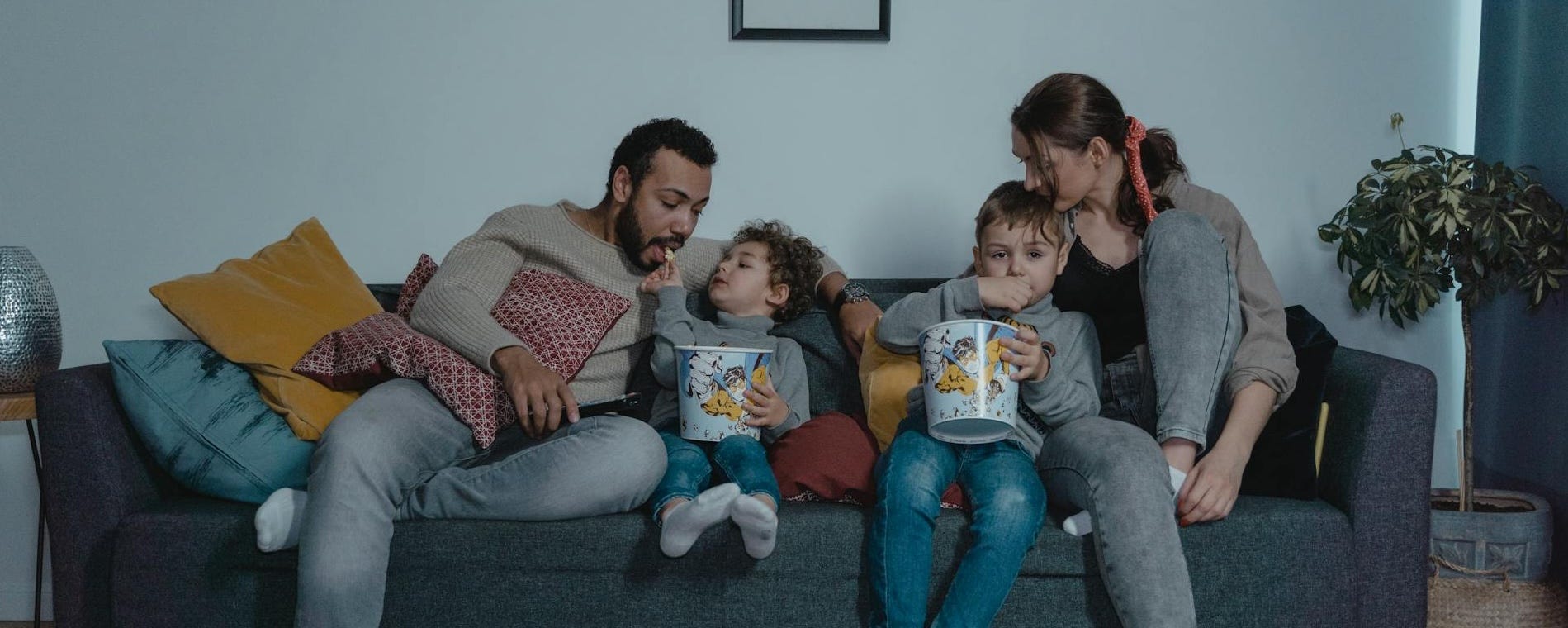
As of this writing, Project Hail Mary has grossed over $500 million at the worldwide box office, and it still appears to have some legs. Word of mouth has remained strong, and part of the reason, I believe, is that whole families can go watch it and enjoy it regardless of age. There’s something for everyone. Children can enjoy something with gravitas and humor, while parents can feel comfortable that nothing obscene will flash on the screen or blare from the speakers.
It’s not a perfect movie, but it’s a well-made, entertaining movie. A family-friendly movie. The type of movie that used to be common. The type of move that assumed that families, parents and children of varying ages, wanted to do things together.
The family movie used to be the norm, but now it’s a rarity. And when you mention the idea of a “family-friendly movie,” some recoil and think you mean a “kid’s movie,” the kind that might be animated, full of juvenile jokes, so many colors and lights swirling and blinking designed to cause seizures in even the most stable minds, and pacing leaves the audience wondering whether they have ADD. All sizzle, no steak. Not so much a movie but an obnoxious theme park ride.
In other words, they think of the Super Mario Galaxy Movie. Something families technically watch together, but no reasonable adult would watch on their own. The parents are along for the ride, much like a hostage in the trunk of a car. These movies are intended to shut the kids up for 2 hours, then be forgotten, and Hollywood is strewn with their ruins and refuse.
The other type of “kids’ movie” rightly derided is one with “very special episode” syndrome, where the aim is not to tell a story but to convey a lesson. Propaganda, in other words. FernGully: The Last Rainforest is a prime example, though that one almost succeeds in being an actual movie. Many movies of this ilk are saccharine sweet and sanitized, and watching them has all the appeal of licking a freshly-bleached kitchen counter top. No sharp corners, and everything is covered in bubble wrap. Others have an outrageous wish-fulfillment as its premise (not a bad idea in concept), but to make the plot happen, every adult in the movie is either an enemy or a moron, especially the parents.
Some movies made for children elevate the art form and become something more (WALL-E, The Incredibles, much of early Pixar); these aren’t the norm, and even Pixar has been lobotomized. “Kids’ movie” is a slur, though it didn’t have to be that way.
But even an elevated, well-crafted kids’ movie is not a family movie. The parents are still incidental observers, even if they end up enjoying the experience.
What is a family-friendly movie?
“Not Everything Needs to Be Made For Kids”
I lamented that A Knight of the Seven Kingdoms could have been a great show if they had made it so families could watch it together. It wouldn’t have taken much. Just remove 10 seconds of nudity and cut the profanity. The show wasn’t that violent (and its main action scene kind of sucks), so they had already dialed it back from typical HBO levels. A shame, because it had a good core with some potential, and decided to tip over the porta-potty to make it more "thrilling" or whatever.
Someone protested that “not everything needs to be made for kids.” But that’s not what I was arguing for. The comment betrayed some fundamental assumptions, not to mention a dumb, juvenile definition of what “for adults” should mean. In the case of A Knight of the Seven Kingdoms, “for adults” meant prosthetic genitalia on display for about 10 seconds. A more charitable interpretation is that people don’t want all the edges sanded off, and they don’t want their only entertainment options to be G-rated fluff.
But again, that wasn’t the point. I don’t want G-rated fluff either, nor do I want it for my kids. A diet cannot consist of only syrup and cotton candy. Does no one read original fairy tales anymore, many of which are full of danger and grotesquerie? There are TV cuts of Die Hard and Terminator 2 that aired on network television, intended to be family-friendly, and both movies, despite the edits, still work and have every single one of their most iconic moments.
Family-friendly movies do not need all of the edges sanded off. They can have sharp corners and frightening moments. They can deal with heavy themes, some of which might float 6 feet above the heads of most children watching. The definition transcends the rating system and transcends genres.
I consider A Quiet Place family-friendly, despite some scary and heavy moments and despite being rated PG-13. There is nothing gratuitous or voyeuristic. The whole family can watch it and get something out of it, and during the scary moments, children can avert their eyes for a second or snuggle in closer to Mom and Dad. Maybe not a nighttime watch, but it’s something the whole family can enjoy, and no one has accused it of “being made for kids.”
Even a movie like Gladiator is almost family-friendly. It wouldn’t take much to make it so, while keeping the core of what works.
Many of the Marvel movies are family-friendly, though many also pushed that PG-13 rating to the limit. Would the franchise have been such a juggernaut if more of them were rated a hard R? Would the original Star Wars have been successful if it included nudity, rape, and more profanity?
And more importantly, would any of these movies be better by making them more obscene?
Every Movie Used to Be a “Family-Friendly” Movie
Once upon a time, it was assumed that families would watch movies together, and so every movie was made with that expectation. Hence, the Hays Code, a set of self-enforced guidelines, partly introduced to avoid regulation coming down on the growing movie industry. The guidelines involved “Don’ts” and “Be Carefuls” so that a movie did not lower “the moral standards of those who see it."
I’m not advocating a return to something like this, nor do I think the code was perfect. It was overly rigid and a product of its time. For example, it allowed no depiction of miscegenation and no ridicule of the clergy. Even though the clergy deserve some ridicule, and sometimes they make it way too easy.
What it did do, however, was force film creators to be creative in telling their stories. Constraints fertilize the soil where creativity grows. Dialogue and cleverness reigned. Some of the greatest films ever made came out of this era. Hitchcock’s best movies were born in this era.
You can still watch Rear Window and North by Northwest with your family, and everyone will have a great time. Would anyone accuse these movies of being made “just for kids?” You’ll also notice that Hitchcock filled his movies with sexual innuendo and imagery, and he certainly didn’t shy away from the darker sides of human nature. I’m not praising him for the innuendo, just highlighting that “family-friendly” does not mean “sanitized.”
Explaining this, I feel like the grandfather from The Princess Bride, promising that the story is not a “kissing book” and there’s actually a lot to get excited about, just keep your shirt on, people. (The Princess Bride being another great family movie, of course). A family-friendly movie can be just as impactful and exciting as any other movie, but — and here’s the kicker — it might take more effort and craftsmanship. You have a few more constraints. You can’t depend on boobies to capture attention. You can’t rely on excessive gore to shock the audience. You must work more on pathos, and not the mere appearance of pathos.
What happened when the expectation that families would watch movies together vanished? Segregation and pandering. One side descended into bright colors, frenetic action, inane plots, poop jokes, and cheap moralizing. The other descended into further depravity, acting like a desperate stand-up comedian who is bombing on stage, who desperately reaches for a sex joke or obscenity as a shortcut to engagement. The two sides have gotten farther and farther apart, though there are rare moments of overlap.
So, What Is a Family-Friendly Movie?
It’s hard to come up with a concrete rule and easier to point to movies, as I’ve done above. Add to that list The Great Escape, The Man Who Shot Liberty Valance (and other westerns), It Happened on Fifth Avenue, and Charade. More modern examples are harder to find, though Master and Commander, Godzilla Minus One, and The Lord of the Rings work well.
However, another modern example that almost made the cut will suffice to help coalesce around a definition. Free Guy could have been family-friendly and still retain 100% of its entertainment power and payoffs. Instead, it’s laced with profanity and crude sex jokes, which add nothing and aren’t funny. Swapping out around 3 minutes of a 2-hour movie, either cutting or replacing it with something that serves a similar purpose, would have made the movie family-friendly. That’s it. And it would have been a better movie.
The only reason to season the milkshake with diarrhea was to snicker the way teenage boys snicker in the back of the room when they think they’re telling a slightly transgressive joke.
So here is my definition.
A family-friendly movie:
Has nothing in it that would cause a teenager to squirm while watching it with their parents. Usually sexual in nature.
Has nothing that would cause the parents to cover their children’s ears.
Has no vivid, extreme on-screen violence or imagery that could give a younger child nightmares.
Does not glorify harmful lifestyle choices and is sensitive in its presentation of them. We don’t need an extended, detailed sequence of someone shooting up heroin.
Notice what is not on the list: tense situations, heavy themes, scary moments. A movie can be genuinely creepy and scary without being nightmare-fuel. It doesn’t have to be bleached and scrubbed of all things interesting. If you don’t believe something can be good, noble, true, beautiful while also being entertaining and exciting unless it’s also laced with arsenic, your taste is broken, and your imagination has been handicapped.
Also, notice that these guidelines exist on more of a spectrum. A movie can still be “family-friendly” and not be appropriate for a sensitive 5-year-old to watch, but 3 years later, they might be ready. Movies like A Quiet Place fall into that category. You know your family. You know your children. Adjust accordingly.
Above all, a family-friendly movie must be a good movie. No one wants to be fed slop or from something scraped from the bottom of the slush pile. A family-friendly movie is not worth watching if it is not, first and foremost, a good movie. It shouldn’t be overly sentimental, didactic syrup.
Why Do I Care?
I want more movies to be family-friendly for purely selfish reasons. My time is limited, and if I’m going to watch a movie, I’d like to watch it with my family. I like my family. I enjoy spending time with them. I enjoy sharing good things with them. If I can’t watch something with my family, I’m probably not going to watch it. Life is too short, and I have more important things to do. Sure, there are services like VidAngel and Clearplay that do an admirable job, and I commend them to you, but that’s a whole other layer of friction.
But my children will also have to deal with other children who have been force-fed “made for kids” slop, their eyelids forced to stay open from pure inertia. When these children crash out or go into withdrawals, unable to pay attention to anything that doesn’t flash at them every 2 seconds, my children will eventually need to pick up the pieces. I want a better future for them, and for these other children. They deserve better.
Children know they are being pandered to, and they long for the day they can watch “real movies.” And because of our extreme segregation, “real movies” usually have sex, gore, and profanity. To be “real,” something must be edgy. What a horrible frame. What a horrible way to train them to look at the world. We had plenty of real movies, and great ones, before our choices split off into inanity or obscenity.
We should demand better.
And if you’re starved for family-friendly stories, I compiled a collection of fantasy and adventure short stories called Fire and Stone. Perfect for read-aloud time, or hand it to your 10-year-old.

Total agreement. Another perfext example of a movie that couldve crossed that line is Pixels. The premise is fun, none if the violence is "scary," but about 3 minutes of gross gags and language couldve been left out easily, leaving behind a fun Friday night film.
I think good stories can only emerge from a concrete understanding of the world. This does not mean they have to preach or exist only to serve a message, but they need to be able to assume some shared perspective among its audience. As we fragment more and more, I think storytellers are defaulting to sex or fireworks to fill in the gaps that culture used to occupy.